
The Testimony Crossed First — The Sixteen Months It Took Japanese Avant-Garde Pioneers to Reach Japan
Set the screening history out as a timeline and the death dates register before the place names.
Japanese Avant-Garde Pioneers opens in Japan on 7 November 2026, at Theatre Image Forum and then other cinemas nationwide. The director is Amélie Ravalec, a French filmmaker based in London1.
A note on where I stand. I have not seen this film. It has not opened in Japan and I did not attend a press screening. What I have is information published by overseas exhibitors, a British film database, English-language criticism, material from the director and her production company, the publisher's page for the companion book, and Japanese reporting derived from the distributor's press release. So I will not write about the editing rhythm or the image quality as though I had watched it.
What can be established now is the route by which this film reached Japan.
Roughly two years from completion to the Japanese release
The UK Films Database, run by the British Council, holds the credits. Running time 100 minutes, production year 2025, format 4K. Directed and edited by Amélie Ravalec; produced by Circle Time Studio in the UK and France; co-produced by Whatsopp Inc. in Japan and Maaserhit Honda; sound by David Crane, music by Gregory Dombrowki. The production company also handles its own sales2.
The screening record lines up like this.
- 1 May 2025 — Dazed publishes an interview with the director3
- 16 July – 3 August 2025 — screened at Fantasia International Film Festival, Montreal4
- 18 July 2025, 18:00 — JAPAN CUTS 2025 at Japan Society, New York. New York premiere, with a director Q&A5
- 25 September 2025 — the companion book Japan Art Revolution is published by Thames & Hudson, 320 pages6
- 2 October 2025, 19:30 — Arnolfini, Bristol7
- Later that year — Bertha DocHouse, London, with a director Q&A and book signing
- Also screened at M+ cinema, Hong Kong
- ARTE, Sky Arts UK and ORF (Austria) acquire broadcast rights8
- 7 November 2026 — Japanese release
Japan Society gives the production year as 2024, while the British Council and the Japanese credits give 202552. Depending on which you take, the span shifts — but it comes to roughly two years from completion to the Japanese release, and about sixteen months from the first audiences to a Japanese cinema.
A record of the Japanese avant-garde arrived in Japan last.
What happened during those sixteen months
The people on screen are living participants. The Japanese press material names Tadanori Yokoo, Keiichi Tanaami, Eikoh Hosoe, Daido Moriyama, Nobuyoshi Araki, Kikuji Kawada and Ishiuchi Miyako, and says the film draws on extensive footage and images of Shuji Terayama and Tatsumi Hijikata1. The British Council synopsis also names Kiyoshi Awazu2.
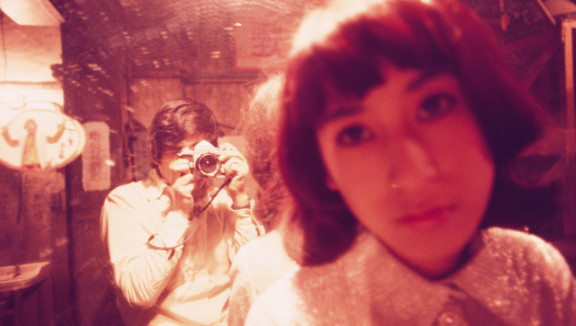
Image source: the film's entry in the British Council UK Films Database (filmsandfestivals.britishcouncil.org), which carries it as the representative image for the film. Rights in the image belong to the producers. The database does not say which chapter it comes from or who took the photograph.
Several of them are gone.
Keiichi Tanaami died on 9 August 2024. Eikoh Hosoe died on 16 September 2024. Both appear in the film in interview. Which means shooting was finished before the summer of 2024, and the film was completed and released after their deaths.
The Dazed piece from May 2025 writes of Hosoe, and of the photography historian Ryuichi Kaneko (d. 2021), that they have "since passed away," and notes that Tanaami also died before release3. Kaneko's name does not appear in the list of participants issued by the Japanese distributor. The same piece names Hitomi Watanabe as an interviewee, and she is likewise absent from the Japanese descriptions.
The director has spoken about this as her reason for making it. She gives Araki's age at the time of filming as 84, says most of her subjects were in their eighties, and that there was "only a small window left"3.
A caution here. Whether this is Tanaami's or Hosoe's final recorded testimony cannot be established. The shooting dates of individual interviews are not public. What can be said is that it contains testimony filmed before their deaths and released after them. Going further would mean asking the director or the production company.
Even so, the sixteen months in which the screenings moved from North America through Europe and Hong Kong to Japan, and the period over which death dates accumulated beside the names, overlap at the same length. For this film, the order of release sits closer to a question of whether the record arrived in time than to a matter of distribution convenience.
There is no Japanese edition of the book
On 25 September 2025, Thames & Hudson published Japan Art Revolution. 320 pages, more than 600 illustrations6. The English-language companion to the film.
I could not find a Japanese edition. But that is not positive proof that none exists — only negative evidence that none was found. Whether one is planned would need to be confirmed with the publisher.
Still, one thing is certain. The most substantial resource on this subject was available in English from September 2025, and is not yet available in Japanese. Film and book both take the Japanese avant-garde as their subject, and both reach Japanese readers and viewers last.
The distributor is thirty-five this year, in the month of release
The Japanese distributor is Only Hearts. Japanese reporting presents the film as the company's thirty-fifth-anniversary documentary1.
According to the company's own profile page, it was founded on 1 November 1991. It is based in Kōjimachi, Chiyoda-ku, Tokyo, with capital of ¥30,000,000; the representative director is Shinpei Okuda, and its business is film distribution and DVD sales9.
A company founded in November 1991 turns thirty-five in November 2026. The release date, 7 November, falls inside that month. Anniversary framing is the kind of thing that slides past as publicity copy, but in this case the dates line up exactly.
The film's Japanese site (zenei.onlyhearts.co.jp) could not be read while writing this. HTTP returns 403, and HTTPS does not connect at all10. So the running time of the Japanese release, whether it carries Japanese subtitles, the specific cinemas and timing behind "nationwide," and the projection specification are all unverified. This will most likely be resolved before opening, so check again before going.
The numbers do not agree
The figures around this film differ by source. Set out as they are:
Running time. Arnolfini, Japan Society and the British Council all give 100 minutes; some Japanese reporting gives about 1052571. Whether something has been added for the Japanese release, or this is simply a discrepancy in listing, is not clear.
Production year. Japan Society says 2024; the British Council and the Japanese credits say 202552.
Years in production. Japanese press says six; in the Dazed piece the director says five, referring to delays caused by the pandemic13.
And the thirteen-chapter structure — the Second World War, photography, Yukio Mishima, PROVOKE, Daido Moriyama, Nobuyoshi Araki, kinbaku, butoh, performance art, Shuji Terayama, angura, Tadanori Yokoo, Keiichi Tanaami — along with the appearance of curators from the Guggenheim in New York and Tate Modern in London, comes only from the Japanese distributor's press material and is unconfirmed in overseas primary sources1.
For that matter, the Japanese coverage is not independent of itself. Eiga Natalie, Eiga.com, CDJournal and CINRA all published around 17 September 2026, and their content, the director's quoted comments and the credits all match. The natural reading is that they derive from the same press release from the distributor, and they cannot be counted as separate sources1. Independent writing about the content exists, for now, only in English-language criticism and interviews.
It is looking at something other than the poster show
Kiyoshi Awazu and Tadanori Yokoo have appeared on this site before. A piece on Revisited: The Art of the Japanese Film Poster, held at the National Film Archive of Japan in 2026, reread film posters from the 1960s to the 1980s as independent graphic works rather than anonymous advertising11. The companion book Japan Art Revolution is described as taking design cues from Yokoo and Awazu as well.
The overlap is not shallow. But what each is looking at differs. The poster show dealt with posters as objects that survive; this film deals with the spoken testimony of people who lived through the period. The former stays available as time passes. The latter does not. That difference runs directly into the question of delay this piece has been circling.
The form of rereading "a movement still waiting for its reappraisal" from outside has been used on this site once already, on the Nouvelle Vague12. This film rides the same form. What differs is that the person doing the recontextualising is a foreigner who is not a native Japanese speaker, and that the results appeared first in English as both a book and a film, with the Japanese-language set still incomplete.
You can see it from 7 November. If the Japanese site is readable by then, several of the unknowns above will close.
Sources
- Japanese Avant-Garde Pioneers — British Council UK Films Database
- Japanese Avant-Garde Pioneers — Japan Society (JAPAN CUTS 2025)
- Japanese Avant-Garde Pioneers — Arnolfini
- Amélie Ravalec official site
- Japan Art Revolution — Thames & Hudson
- Company profile — Only Hearts
- Amélie Ravalec interview — Dazed (1 May 2025)
- Japanese Avant-Garde Pioneers to open in November — Eiga.com (17 September 2026)
- Japanese Avant-Garde Pioneers review — Asian Movie Pulse
- From anonymous advertising to artwork — Revisited: The Art of the Japanese Film Poster
- What was the Nouvelle Vague, really
Footnotes
-
Eiga.com, 17 September 2026. The Japanese release date of 7 November 2026, Theatre Image Forum and other cinemas nationwide, director Amélie Ravalec, six years of production, the thirteen-chapter structure, the participants (Tadanori Yokoo, Keiichi Tanaami, Eikoh Hosoe, Daido Moriyama, Nobuyoshi Araki, Kikuji Kawada, Ishiuchi Miyako), the footage of Shuji Terayama and Tatsumi Hijikata, the inclusion of comments from curators at the Guggenheim and Tate Modern, the running time of about 105 minutes, and the framing as Only Hearts' thirty-fifth-anniversary film all come from this article. Eiga Natalie (11:00), CDJournal and CINRA reported the same content around the same date, and since their content, quoted comments and credits match, this piece treats them as deriving from a single press release from the distributor rather than as independent sources. ↩ ↩2 ↩3 ↩4 ↩5 ↩6 ↩7
-
The work's entry in the UK Films Database run by the British Council. Running time 100 minutes, production year 2025, format 4K, directed and edited by Amélie Ravalec, produced by Circle Time Studio (UK/FR), co-produced by Whatsopp Inc. (JP) and Maaserhit Honda, sound by David Crane, music by Gregory Dombrowki, sales contact films@circletimestudio.com, and the reference to Kiyoshi Awazu in the synopsis, all from this page. ↩ ↩2 ↩3 ↩4 ↩5
-
Dazed, 1 May 2025. The director's own statement of five years in production, the pandemic delays, the description of Eikoh Hosoe and Ryuichi Kaneko (d. 2021) as having "since passed away," the note that Keiichi Tanaami died before release, the inclusion of Hitomi Watanabe among the interviewees, and Araki's age of 84 at the time of filming alongside the "only a small window left" account of motivation, all from this article. Where the figures in this piece disagree with the Japanese press, the disagreement originates here. ↩ ↩2 ↩3 ↩4
-
The Asian Movie Pulse review from the Fantasia 2025 screening. The Fantasia International Film Festival ran from 16 July to 3 August 2025. The festival's own page for the film returns 404 as of writing, so the screening date there and whether this was a world premiere could not be confirmed. The only first-screening designation that can be confirmed is Japan Society's "New York Premiere." ↩
-
The JAPAN CUTS 2025 screening page at Japan Society, New York. 18 July 2025 at 18:00, New York premiere, director Q&A, production year given as "2024," projection as DCP in colour, and the note "English and Japanese with English subtitles," all from this page. ↩ ↩2 ↩3 ↩4
-
The Thames & Hudson product page. Japan Art Revolution, published 25 September 2025, 320 pages, more than 600 illustrations. No Japanese edition could be found in searching, which is not proof that none has been published. ↩ ↩2
-
The screening page at Arnolfini, Bristol. 2 October 2025 at 19:30, running time 100 minutes, participant list, and the credits for Circle Time Studio (UK/FR) with Whatsopp Inc. (JP) as co-producer. The London screening took place at Bertha DocHouse, so this piece does not treat the European screenings as having premiered in London. ↩ ↩2
-
Amélie Ravalec's official site and the film site japanavantgarde.com. Broadcast rights acquired by ARTE, Sky Arts UK and ORF, the M+ cinema screening in Hong Kong, and the director Q&A and book signing at Bertha DocHouse, all from these sites. ↩
-
The company profile page of Only Hearts. Founded 1 November 1991; address 3-12-3 Kōjimachi, Chiyoda-ku, Tokyo, Tōga Kōjimachi Building 2F; capital ¥30,000,000; representative director Shinpei Okuda; principal business film distribution and DVD sales; affiliated companies Ask Publishing and Meifazu (checked 18 September 2026). A November 1991 founding places the thirty-fifth anniversary in November 2026. ↩
-
As of 18 September 2026, the Japanese film site zenei.onlyhearts.co.jp returns 403 to HTTP requests and does not complete an HTTPS connection (the domain does not respond on port 443). The distributor's corporate site onlyhearts.co.jp is readable over HTTP. Accordingly the running time, presence of Japanese subtitles, names and timing of cinemas nationwide, and projection specification for the Japanese release are unverified here. ↩
-
This site's earlier piece on Revisited: The Art of the Japanese Film Poster, covering the exhibition at the National Film Archive of Japan (7 April – 26 July 2026), which names Kiyoshi Awazu and Tadanori Yokoo. ↩
-
This site's earlier piece on the Nouvelle Vague, rereading "a movement still waiting for its reappraisal" as the first generation of obsessive consumers to pick up cheap tools. ↩