
He Stepped Out of the Frame and Left the Camera Behind — Shinya Tsukamoto's Mr. Nelson, Did You Kill People?
Note
I have not seen this film. It opened on 11 September 2026; this was written the following day. Nothing is asserted about the finished picture. Everything here comes from the poster, released production stills, statements by the director and cast, and the credits. Quotations from Japanese sources are translated here.
After collecting his prize in Venice, Shinya Tsukamoto said this:
If this film had not happened, I thought I might draw it as a manga myself, or become Mr. Nelson in a one-man show or something, and tour Japan with it1
Mr. Nelson is Allen Nelson (1947-2009), an African American who enlisted in the US Marines at eighteen, was sent to the Vietnam front in 1966, came home to years of PTSD, and eventually spent his life telling audiences what he had done there.
A 66-year-old Japanese film director is saying he would have become him. As a manga, as a solo performance — whatever it took, using his own body.
That is the oldest habit this filmmaker has. And Mr. Nelson, Did You Kill People? is the film in which he finally did not act on it.
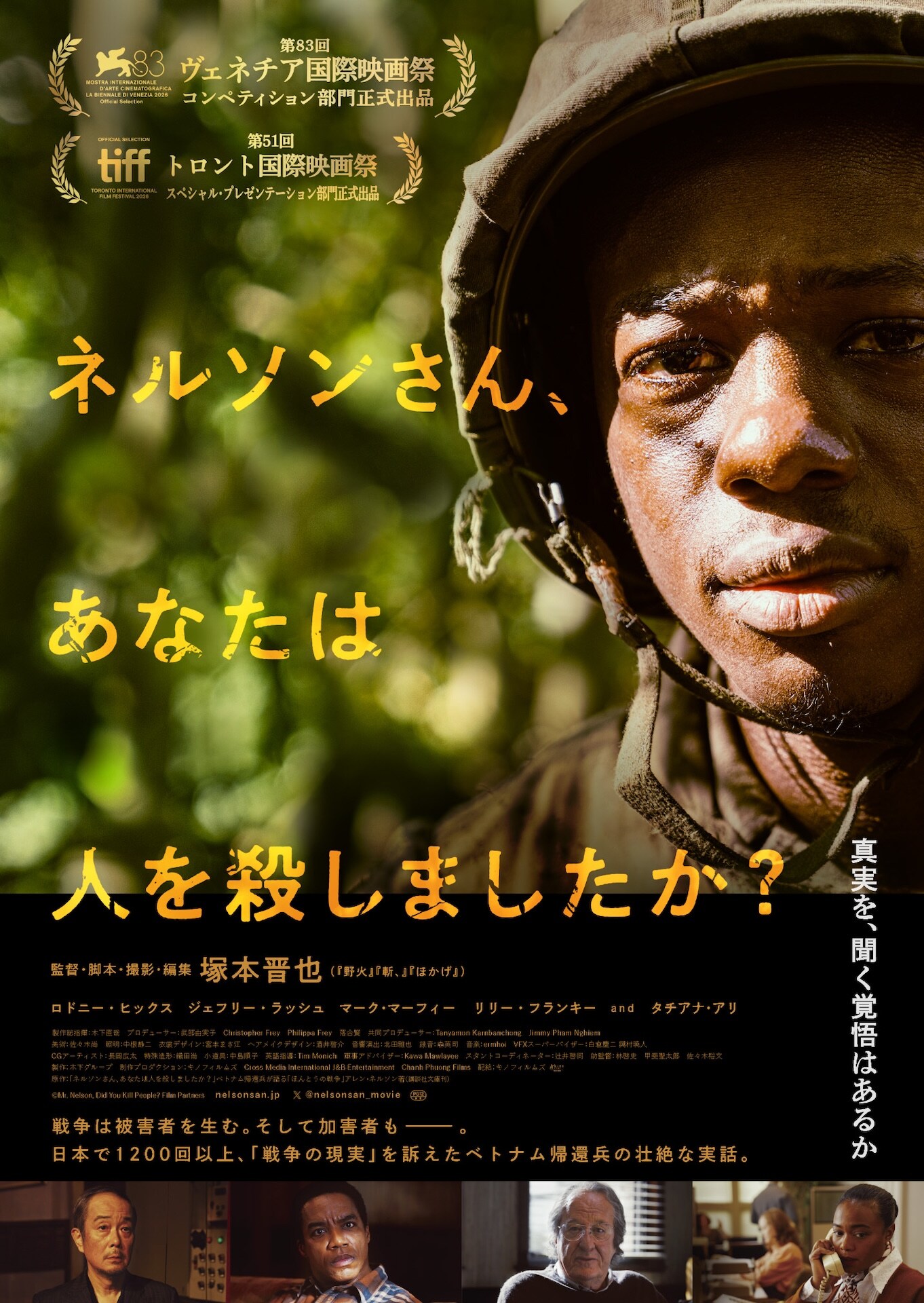
Image source: Eiga Natalie (natalie.mu)
What this piece argues
Tsukamoto measures the distance between violence and the body. For most of his career, the measuring instrument was his own body.
Look at the credits for Mr. Nelson, Did You Kill People? and his name appears under director, screenplay, cinematography and editing. It does not appear in the cast2. The instrument has left the frame.
But not all of it. He is still the one shooting. In the form of a camera, his body stayed within arm's reach of the actors.
That arrangement lines up precisely with something he has said about war: the further away you are, the more cowardly the act of harming becomes. If that is the measure, then shooting from up close is not a style. It is the measure being applied to himself.
The film
Japan, 2026. 116 minutes, rated PG12. Written, shot, edited and directed by Shinya Tsukamoto. Produced by Kinoshita Group, distributed by Kino Films. Opened 11 September 2026 at kino cinéma Shinjuku and other theaters3.
It is based on Allen Nelson's nonfiction book, published in Japanese as Mr. Nelson, Did You Kill People? A Vietnam Veteran Tells of the Real War (Kodansha Bunko), with My Heart Broke on the Battlefield: Testimony of a Former Marine (Shin Nihon Shuppansha) listed as a further reference4.
Rodney Hicks, an original cast member of Broadway's RENT, plays Allen Nelson. Geoffrey Rush plays the psychiatrist Neal Daniels. Mark Murphy plays the young Allen, Tatyana Ali plays Linda, and Lily Franky plays a Japanese man named Kuroi2.
Shooting took place in New York, Vietnam, Thailand and Okinawa. Permission to film the combat scenes in Vietnam was refused, so they were shot in Thailand4. Tsukamoto began the plot in 2018; principal photography started in February 20254. He describes the struggle to finish as lasting "seven years"5, while press coverage calls it a ten-year project6.
The film screened in competition at the 83rd Venice International Film Festival and won the Leoncino d'Oro, one of the festival's collateral prizes. It is the first Japanese film to take it7.
In Tetsuo the distance was zero
For Tetsuo (1989), Tsukamoto handled directing, writing, producing, cinematography, lighting, production design and special effects himself — and appeared in it as well8.
What happens in that film is metal breaking through skin and burying itself in meat. A drill grows out of a man's body. There is no gap between the iron and the flesh. It is not the usual cyborg division of labor, human brain up here and metal arm down there; the inorganic and the organic get mashed together.
Tsukamoto explains the feeling this way:
Human beings have been in a love affair with metal from the moment it appeared in the world. Used well it becomes a tool, like a farming implement, but a simple stick was a weapon from the start9
A love affair. Meaning: no distance at all. And metal at zero distance can be either a tool or a weapon.
So the subject was already there in 1989 — the distance between a person and the thing that can injure them. It was simply that the distance was zero and the violence was still fantastical.
In Silence, Tsukamoto became a component
In Martin Scorsese's Silence (2016), Tsukamoto plays Mokichi, a Christian peasant in Nagasaki. He appeared in someone else's film, as an actor.
He dropped below 50 kilograms for the role and said that "even standing up, I had to grab hold of something." Of the martyrdom scene he said it was "a film worth thinking, if I happen to die shooting this, so be it"10.
He also described where he places himself as an actor:
All I think about is becoming the director's slave. Rather than bringing some fixed method of my own, I go to the set with a clear-water frame of mind, to become a component that neither sticks out nor recedes, so that the director can do what they want to do11
A component. Offering up his own body as material for another person's will.
He also said that Silence and Fires on the Plain shared a theme: "the anguish of having what matters most to you bent out of shape by the violence of some power"11.
Two things coincide there. What is being performed — a believer whose body is crushed by state power — and the posture of performing it — an actor handing his body to a director's authority — have the same shape. Tsukamoto used the profession of acting itself as a way to understand Mokichi.
Worth adding: when he described what he held in mind for the role, he named two things. Faith in Scorsese, and "a wish to offer a prayer to the children of the future, now, when war might break out again"10. That was 2016.
The body left the frame in stages
Here I need to correct my own diagram.
When I first laid this out, I was going to write that Mr. Nelson is the first time Tsukamoto stepped out of the frame. That is simply wrong.
- Tetsuo (1989) — director, cinematographer and more; appears in the film8
- Fires on the Plain (2014) — director, producer, writer, cinematographer, editor; plays the lead, Private Tamura12
- Killing (2018) — director, producer, writer, cinematographer, editor; appears as Sawamura Jirozaemon13
- Shadow of Fire (2023) — director, writer, cinematographer, editor. Not in the cast14
- Mr. Nelson, Did You Kill People? (2026) — director, writer, cinematographer, editor. Not in the cast2
The withdrawal starts with Shadow of Fire. Lead, then supporting, then absent: three stages of leaving the picture.
What differs this time is the kind of absence. Shadow of Fire is set in the burnt-out streets of postwar Japan, where he could have taken any number of parts. The person at the center of this film is a real, dead African American man. He could not have played him if he wanted to.
Which is why "become Mr. Nelson in a one-man show and tour Japan" is not modesty. His default setting is still do it myself. Choosing a subject where that is impossible already puts this film in an unusual position in his work.
What stayed behind was the camera
So what remains after the body leaves? The cinematography.
Geoffrey Rush gave this account at the Venice press conference:
In the scenes where the doctor is counseling Nelson, I could feel him behind me, working the camera around and around, searching for what he wanted6
The director himself, camera in hand, moving behind the actor. Not an operator — the director. Close enough that an actor can feel him without turning around.
Rodney Hicks describes the same set from another angle:
He's like a Zen master. Calm and generous. […] He doesn't say cut for a long time, which threw me on the first day, but I got used to it fast6
He does not call cut. Which means the body holding the camera stays there after the performance has finished.
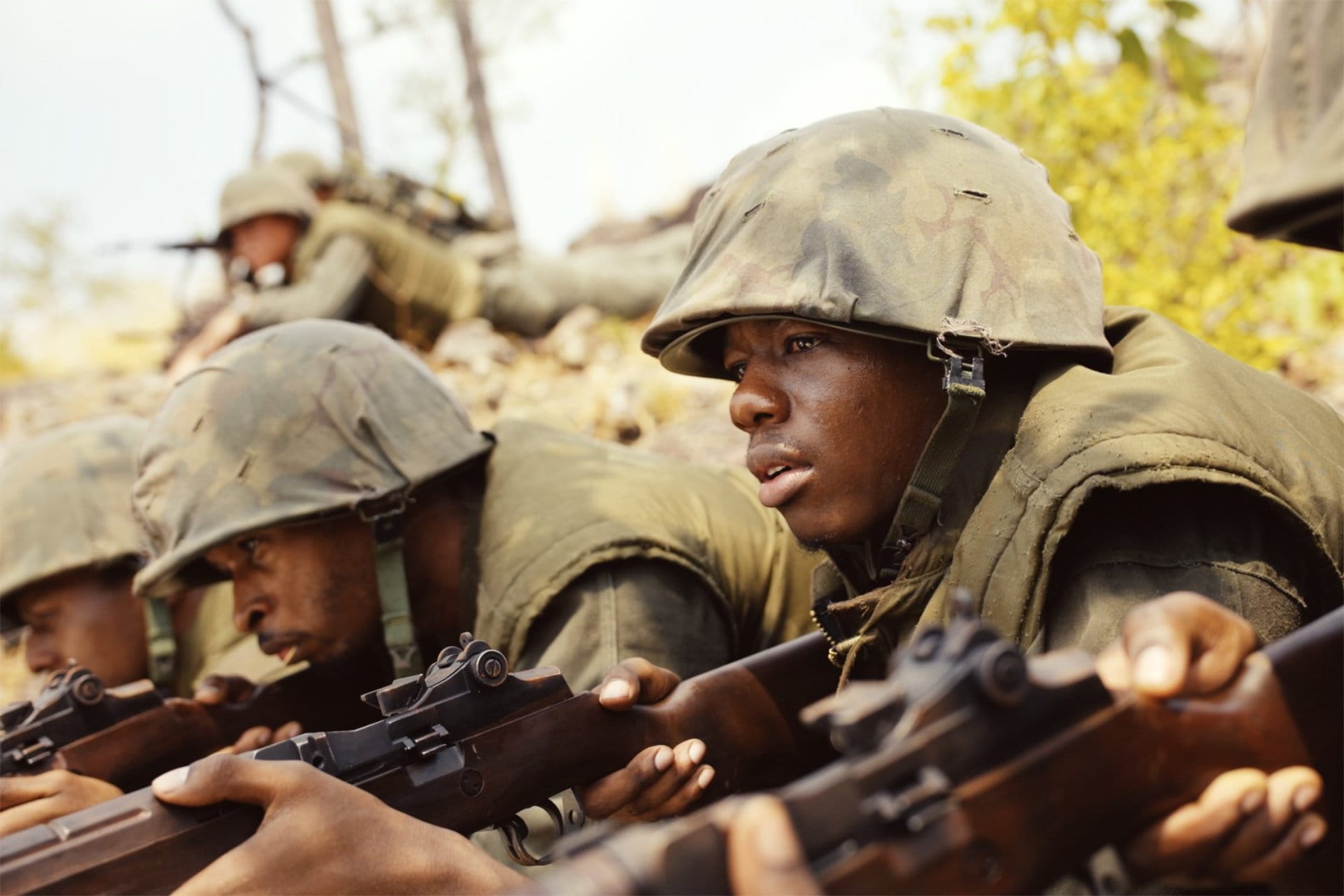
Image source: Eiga Natalie (natalie.mu)
In the released stills, the camera sits at the same height as the prone soldiers. Rifle barrels and faces line up on nearly the same plane, and whoever is shooting is inside the row. The poster does the same thing, pressed close enough to a face to count the beads of sweat.
These are publicity materials, chosen to sell the film, so they need not represent the average distance in the finished picture. What they do show is which images the distributor wanted to present as what kind of film this is.
One more thing. The music credit this time reads ermhoi2. Chu Ishikawa, who scored nearly everything Tsukamoto made from Tetsuo onward, died in December 201715, and yet his name still appears on the music credits of Killing and Shadow of Fire1314. This is the first film without it. The director's body is not the only thing that left.
A scale of cowardice
Back to the director's own words, from an interview about drones and AI-directed attacks:
Violence is wrong to begin with, but the further away you are from the victim, the more the degree of cowardice increases. A terrible cowardice began with the history of the handgun, and it kept extending the distance, until with missiles it feels like the outer limit of cowardice. And with drones you press a button as if you were playing a game, so at a glance there is no sense of guilt at all9
"Degree of cowardice" treats distance as an ethical measure. The weight of an act of harm is gauged not by how many you killed but by how far away you were when you did it.
Apply the same scale to the side holding the camera.
Filming a war from far off, from a safe position, in overhead shots, is cowardly by this measure. In which case carrying the camera in behind the actor with your own body and refusing to call cut stops being a method and becomes the ethic being carried out.
Tsukamoto revises himself in the same interview, though. He had heard about how drone operators actually work — they watch a target's family for days before they fire.
Some of them apparently go to the family afterwards and tell them directly, I'm sorry. Whatever the method, an act of harm seems to leave trauma in one form or another9
He is dismantling his own neat equation that distance erases guilt. That seems to me an honest thing to do, and it means this piece should not push the equation the other way either — close range does not automatically mean integrity.
Chosen by twenty eighteen-year-olds
The Leoncino d'Oro is judged by twenty eighteen-year-old students selected from across Italy, who pick a winner from the competition lineup. Park Chan-wook's Sympathy for Lady Vengeance and Wes Anderson's The Darjeeling Limited have won it before7.
Tsukamoto's comment:
Of course I want as many people as possible to see this film, but I feel very strongly about wanting young people to see it7
That is not post-award politeness; it matches what he was saying before the film was finished. The film is rated PG12, so viewers under twelve can watch it with a guardian's guidance. He explains the decision this way:
Trauma from a screen is weak compared with trauma from an actual war. It might leave a scar, but it is better to take the shock as early as possible, so that when war really does come close, your body reacts by rejecting it. It's something like a vaccination4
Immunity, vaccination, rejection. All of it the vocabulary of the body.
He is not trying to get audiences to understand that war is bad. He is trying to put something into them. Held in the head as knowledge it does not work, but lodged in a cell it produces revulsion on its own when the real thing approaches. He is building the film as that kind of device.
And the design points the same way as what he says he carried into the martyrdom scene ten years earlier: a prayer offered to the children of the future10.
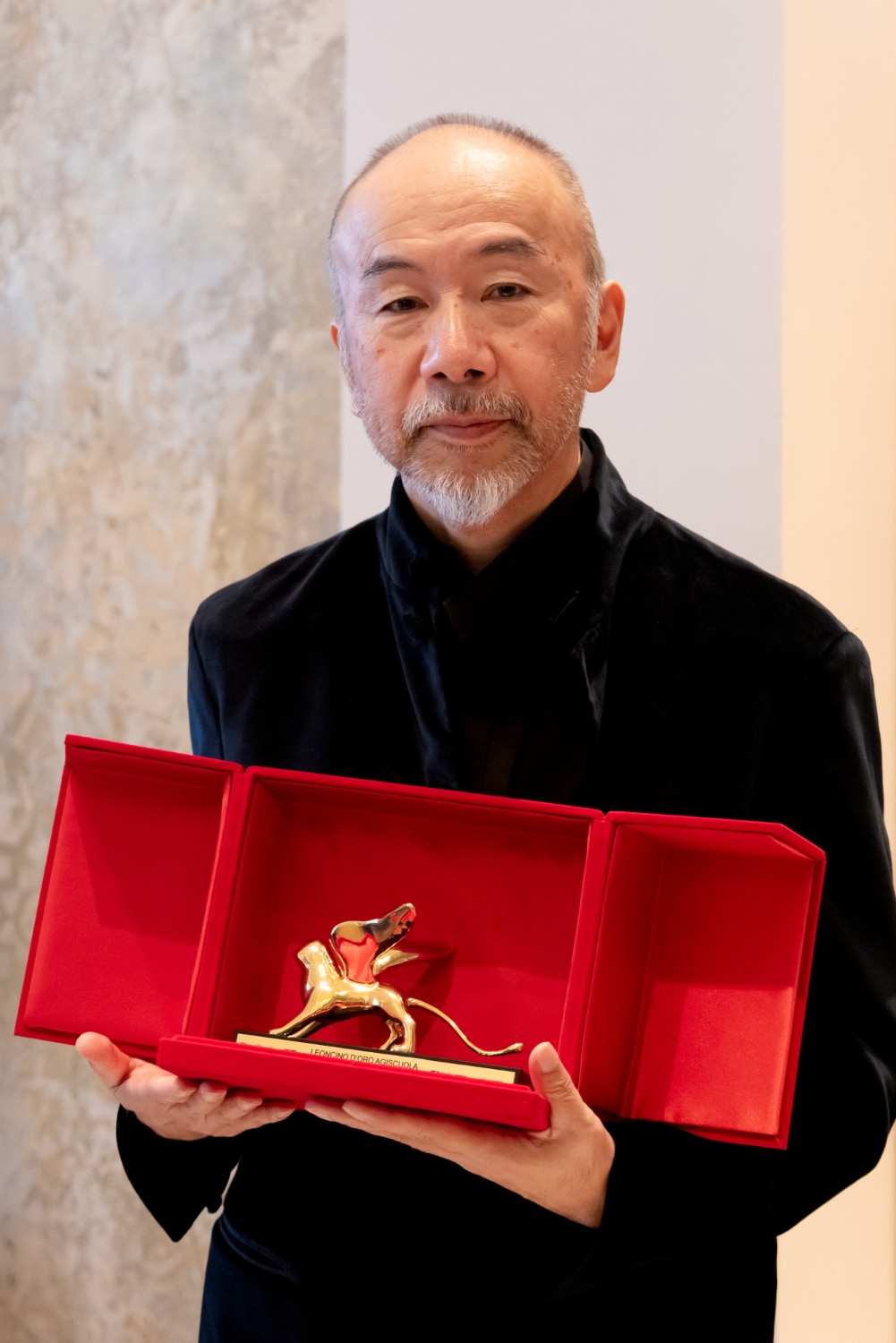
Image source: Eiga Natalie (natalie.mu)
Where this reading could be wrong
Three weak points.
First, his absence from the cast may be practical rather than philosophical. There is no role for a middle-aged Japanese man in an African American's story. That alone could account for it. There is a Japanese character, Kuroi, played by Lily Franky, but putting the director in that part would tilt the film's center of gravity toward Japan.
Second, the central observation here — that the camera stayed close — rests on one account from Geoffrey Rush, on stills chosen for publicity, and on inference from earlier films. It is a diagram drawn by someone who has not seen the picture.
Third, this piece tries to read a filmmaker's thinking off a credit block. That can also be a convenient way of not watching the film. Whether the reading holds will be obvious within minutes of sitting down in the theater.
Even so, there is a reason to write it on the second day of the run. That this director has spent thirty-seven years since Tetsuo changing where he puts his own body is a fact you can check before watching. Afterwards, there will probably be nothing to write about except the film itself.
Related reading
On state violence delivered as one person's practical errand rather than as an argument, there is what I wrote about A Foggy Tale. The difference with Tsukamoto is that he kept putting his own body in the position of that one person.
On shooting and cutting everything yourself, this connects to the idea of working backwards from what you can actually film. Tsukamoto did not end up alone by working backwards; he turned working alone into the method itself.
On the danger of films that arrive directly in the body, where the same vibration can be pleasure or destruction, there is the piece on SIRAT. Tsukamoto's word "vaccination" is chosen in full knowledge of that danger.
On whether artists should speak about politics, I once worked through it from the music side. Allen Nelson speaking about Article 9 more than 1,200 times in Japan4 belongs to the same territory.
Sources
- Mr. Nelson, Did You Kill People? official site
- Mr. Nelson, Did You Kill People? film page — Eiga.com
- Why Shinya Tsukamoto chose the Vietnam War now — nippon.com
- Shinya Tsukamoto on why he keeps making films about war — Gizmodo Japan
- Tsukamoto's new film to open in September, on the wounds of the perpetrator — Eiga.com
- 83rd Venice Film Festival: rapturous applause for Mr. Nelson, Did You Kill People? — Eiga.com
- Tsukamoto on the Leoncino d'Oro: "I especially want young people to see it" — Eiga.com
- Tsukamoto's Mr. Nelson, Did You Kill People? takes the Leoncino d'Oro in Venice — Eiga Natalie
- Shinya Tsukamoto interview on Silence — Real Sound
- Down below 50kg for Scorsese's Silence: Tsukamoto could barely stand — Cinema Today
- Composer Chu Ishikawa, who scored Tsukamoto's films, has died — Eiga Natalie
- The Texture of Fog — How A Foggy Tale Delivers White Terror Through One Person's Errand
- How to Make a DIY Film by Starting From What You Can Actually Shoot
Footnotes
-
Eiga Natalie, 12 September 2026, from the scrum after the Leoncino d'Oro ceremony. In the same session he said that "my only aim was to bring Mr. Nelson, who died seventeen years ago, back to life once more." ↩
-
Staff and cast listing on the Eiga.com film page. Director, screenplay, cinematography and editing: Shinya Tsukamoto. Music: ermhoi. Sound design: Masaya Kitada. Cast: Rodney Hicks (Allen Nelson), Geoffrey Rush (Neal Daniels), Mark Murphy (young Allen), Lily Franky (Kuroi), Tatyana Ali (Linda). The official site and the poster carry the same credits, and none of them list Tsukamoto as a performer. ↩ ↩2 ↩3 ↩4
-
Eiga.com film page. 2026 / 116 minutes / PG12 / Japan; distributed by Kino Films; released 11 September 2026. Theater information from the official site. The March 2026 announcement had described the release as "TOHO Cinemas Chanter and nationwide." ↩
-
nippon.com, 12 September 2026, interview with Shinya Tsukamoto. The bibliographic details of the source book and further reading, the shooting locations, the reasoning behind the PG12 rating, and the references to Allen Nelson's lectures and Article 9 all come from this piece, as do the start of photography and the year the plot was begun. The figure of more than 1,200 lectures is secondary information based on announcements by those involved. ↩ ↩2 ↩3 ↩4 ↩5
-
Full directorial comment published by Eiga.com on 29 March 2026: "the push and pull between I have to make this and I want to run away went on for seven years, right up to completion." ↩
-
Eiga.com, 5 September 2026, from the press conference around the world premiere at the 83rd Venice International Film Festival. The statements by Geoffrey Rush and Rodney Hicks, and the description of the film as a ten-year project shot in four countries, come from this article. ↩ ↩2 ↩3
-
Eiga.com, 12 September 2026. The jury format for the Leoncino d'Oro (twenty eighteen-year-old students selected from across Italy), the first Japanese win, the list of past winners, the director's comment and the summary of the jury citation all come from this article. ↩ ↩2 ↩3
-
Eiga.com film page. Tetsuo (1989, 67 minutes). Tsukamoto took directing, writing, producing, cinematography, lighting, production design and special effects, and appears in the film. Tomorowo Taguchi stars; music by Chu Ishikawa. ↩ ↩2
-
Gizmodo Japan, 12 September 2026, interview with Shinya Tsukamoto. His view of technology at the time of Tetsuo, the remarks on drones and "degree of cowardice," and the comment on trauma among those who do the harming all come from this interview. ↩ ↩2 ↩3
-
Cinema Today, November 2016, from a press conference at the Twenty-Six Martyrs Museum in Nagasaki. The remarks about dropping below 50kg, about needing to hold on to something in order to stand, about the martyrdom scene, and about the state of mind he brought to the role all come from this article. ↩ ↩2 ↩3
-
Real Sound, January 2017, interview with Shinya Tsukamoto at the release of Silence. The remarks about becoming "the director's slave" and "a component," and about the shared theme between Fires on the Plain and Silence, come from this interview. ↩ ↩2
-
Eiga.com film page. Fires on the Plain (produced 2014, released 25 July 2015, 87 minutes, PG12). Tsukamoto directed, produced, wrote, shot and edited it, and played Private Tamura. Music by Chu Ishikawa; distributed by Kaijyu Theater. ↩
-
Eiga.com film page. Killing (2018, 80 minutes, PG12). Tsukamoto directed, produced, wrote, shot and edited, and appears as Sawamura Jirozaemon. Music credited to Chu Ishikawa. Screened in competition at the 75th Venice International Film Festival. ↩ ↩2
-
Eiga.com film page. Shadow of Fire (2023, 95 minutes). Tsukamoto directed, wrote, shot and edited. The cast is Shuri, Oga Tsukao, Hiroki Kono, Go Riju and Tatsushi Omori; Tsukamoto is not listed. Music credited to Chu Ishikawa. Won the NETPAC Award in the Orizzonti section of the 80th Venice International Film Festival. ↩ ↩2
-
Eiga Natalie obituary, December 2017. Chu Ishikawa (1966 – 21 December 2017) met Tsukamoto in 1988 and scored nearly all of his films from Tetsuo (1989) through Fires on the Plain (released 2015). He died before Killing was finished, and Tsukamoto assembled the final score from the music Ishikawa had written. Whether the music credit on Shadow of Fire covers existing recordings or unreleased material could not be established beyond the Eiga.com credit listing; unverified. ↩