
Rei Kawakubo's Words Are Not the Answer to Her Clothes
We look at clothes and ask what they mean. An answer from the designer offers some reassurance. We take it back to the work and feel we understand.
Rei Kawakubo's brief answers interrupt that sequence. Less because she is a person who refuses explanation than because a gap remains between the question we prepared and the thing she made. I would rather stay with that gap than fill it with a story about the silent genius.
On October 23, 2026, Courrier Japon introduced Kawakubo as a person who does not speak, drawing on a Le Figaro article that takes Lost in Translation as a reference. Only its public excerpt was accessible; the members-only remainder was not. This essay therefore borrows neither the film comparison nor the article's overall conclusion.1
What follows reads a separately available interview and museum materials. It is neither an assessment from handling the garments nor an account of attending an exhibition or performance.
A quiet designer still gives specific answers
In an interview published by Dazed on August 27, 2026, Kawakubo connects black with resistance, justice, and independence. Asked about vivid pink in the same collection, she assigns it no particular meaning, describing its role in intensifying black.2
Words are present. For black she gives meanings; for pink she describes a relationship between colors. Not every element needs to be explained by one philosophy.
That difference helps when looking at photographs of the clothes. If pink suggests femininity to us, that is initially the viewer's association. Her explanation does not coincide with it. We need neither prohibit the association nor declare the designer wrong. We can identify whose account we are giving.
The author's words do not bring interpretation to an end.
A question comes back with its premise exposed
Asked in the same interview about clothes and the body, Kawakubo replies that their relationship is not the theme. On deliberately moving an audience, she also distinguishes seeking something new from knowing what it will bring about.2
Clothes appear to alter the body, so we ask how the designer wants to alter it. A reasonable question. But it assumes that the visible effect must have been the original purpose. Her answer interrupts that assumption.
The motive before making and the effect afterward need not coincide. If we turn what we strongly felt into the reason a work was made, an event on the viewer's side becomes the author's property too.
This is no reason to revere brevity. We can ask whether a short answer addresses the question and which premise it rejects. Ending a conversation is not the same as disproving a viewer's interpretation.
The 1997 volumes are more specific than an explanation
The spring/summer 1997 collection Body Meets Dress—Dress Meets Body provides something concrete to return to. MoMA's account describes padding placed at the abdomen, hips, back, and shoulders: gingham paired with volumes extending beyond the body's outline.3
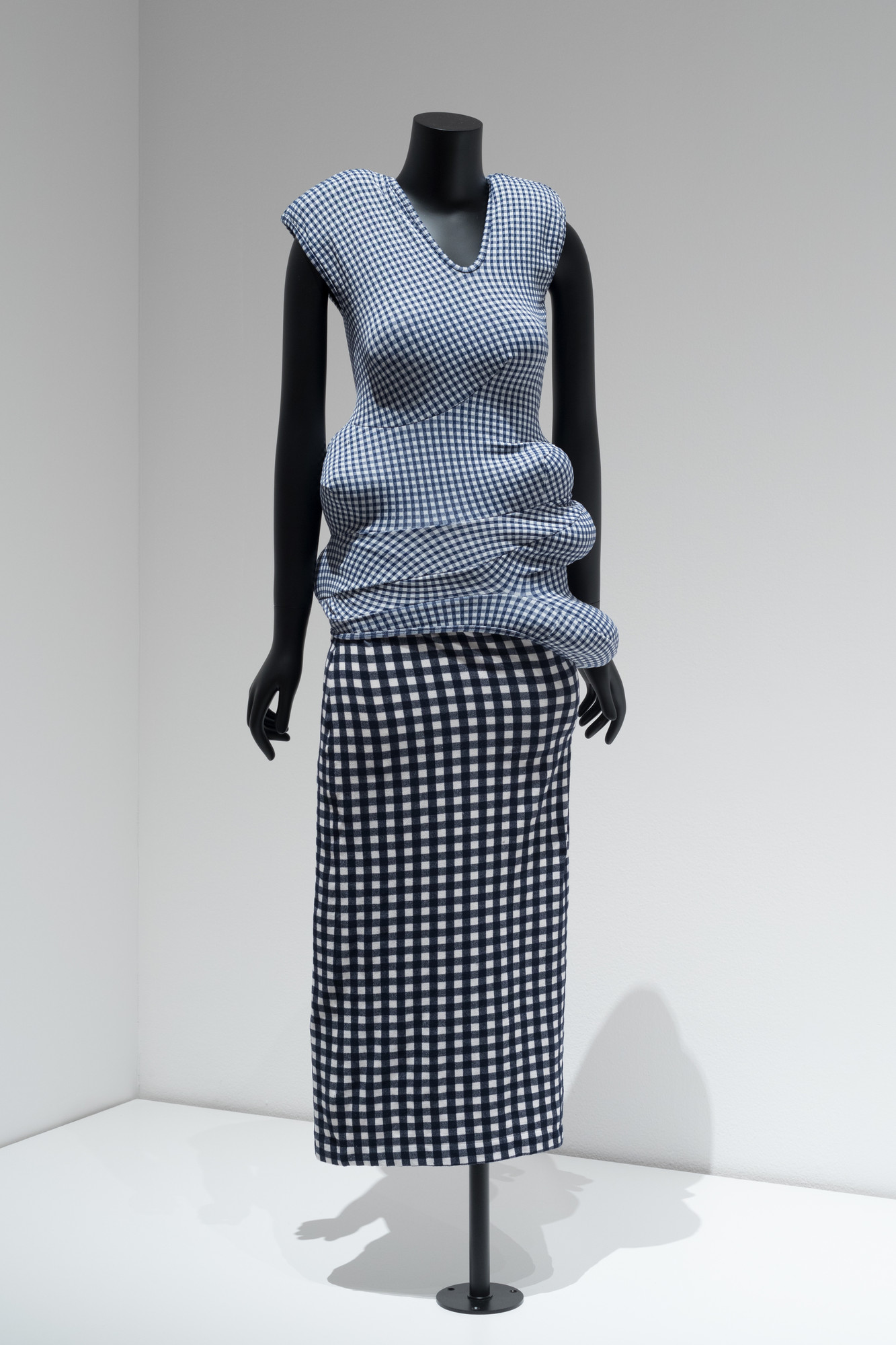
Clothes can follow a body or make it look larger. Neither is unusual. Yet changing where volume accumulates unsettles a familiar figure. Where we expected shaping that narrows the waist, volume appears elsewhere. It becomes harder to decide where the garment ends and the body begins.
This is a reading of the documented placement and shape of the padding, not an assessment of weight or comfort from wearing it.
MoMA's commentary also describes fashion magazines showing the clothes with their padding removed. Removal makes them easier to accommodate as familiar garments. It also removes the disturbance they introduced. Translating something into an understandable form does not necessarily convey it better.3
Writing can perform a similar operation. Calling a collection a challenge to beauty standards may not be wrong, but it loses where the swelling occurs and what it makes unfamiliar. As an explanation becomes tidier, the clothes become more ordinary.
The question moves to a moving body
The Met's account of its 2017 exhibition connects these forms with Scenario, the collaboration with Merce Cunningham that premiered on October 14, 1997. It discusses the padded garments in relation to movement.4
I have not seen the performance and cannot describe how a particular movement changed. But a still photograph leaves questions it cannot answer. What does the volume at the back look like during a turn? How does it affect the space between neighboring dancers? Reading a shape in a photograph and watching it being worn through time require different evidence.
Documents can make the next encounter more specific. Before concluding broadly that the work rethinks the body, I want to see which outline moves.
Do not turn silence into authority
Receiving an unexplained work takes effort. If only those who already know the context can look as though they understand, silence raises the threshold. Perhaps this is one reason criticism and museum language gather around the clothes: the distance needs to be crossed.
I do not want to praise a lack of explanation unconditionally. It guarantees no quality, and a puzzled reader is not at fault. What helps is language that shows where to look and what can be checked, without deciding one meaning in advance.
The essay on Mamoru Oshii's film criticism separated learning where to look from agreeing with a critic's conclusion. We can keep that distance from an author's words too.
After reading her answer about black, look at its placement beside pink. When told that the body is not the theme, try to say again, through the clothes' shapes, why the body came to mind. Keep what the words explained beside the forms they have not resolved.
Sources and scope
Checked October 24, 2026. The August interview and 1997 clothes are not presented as this week's announcements. The film comparison, wearing experience, and performance movement remain unverified.
Footnotes
-
Courrier Japon, 「語らざる人」川久保玲, October 23, 2026. Gino Delmas / Le Figaro. Public excerpt only. ↩
-
Ted Stansfield, Rei Kawakubo on AI, the colour black and her advice for young designers, Dazed, August 27, 2026. The interviewee's answers are distinguished from the journalist's descriptions. ↩ ↩2
-
MoMA, Body Meets Dress—Dress Meets Body Ensemble. Commentary by Francesca Granata on placement, materials, and reception. The work can be viewed at the source. ↩ ↩2
-
The Metropolitan Museum of Art, Exhibition Galleries, documentation of the 2017 exhibition. The Object/Subject section supplies the garment description and record of Scenario. ↩