
Two Names, Side by Side — How Kyoto's 40-Year Manga Show Arranged the Children Who Came Back
The first thing you notice reading the checklist from the top is not where the artists are from. It is how many names there are.
The Kyoto International Manga Museum opened "Children Who Grew Up With Manga: Forty Years of Manga Culture in Europe" on 17 September 2026. It runs until 19 January 2027, in Galleries 1, 2 and 3 on the second floor. Viewing is free; you pay only the museum admission1.
The show is in three parts. The first covers the history of reception in Europe from the late 1980s. The second is titled "The Former Children Who Came Back as Manga Creators." The third is a reading corner where visitors can read work by European Manga creators freely1.
A note on where I stand. I have not seen this exhibition. What I have is the organiser's official page, the announcement from Kyoto Seika University, the City of Kyoto's programme listing, and serialisation information published by the works' Japanese publisher. So I will not write about the circulation of the rooms or the density of the hang as though I had walked through them.
What can be read now is the shape of the checklist on the official page. And it points somewhere slightly off from the frame the show has given itself.
Of the ten entries, only four carry a single name
The participating creators and works listed on the official page, in alphabetical order, are these ten, followed by "and others"1.
- Christina Plaka, Yonen Buzz, Kimihe
- Diane Truc / Rutile, Colossale
- Guillaume Singelin / Mathieu Bablet, Shin Zero
- Hagane / Izu, Kraken Mare
- Shoji Fujimoto / Juan Albarran, Matagi Gunner
- Kenji Tsurubuchi / Konata, Meaheim
- Mogiko, Black Letter
- Sozan Coskun, Kiela und das letzte Geleit
- Tony Concrete, Majo no Michi
- Yoann Vornière, Silence
Six of the ten set two names against a slash. Four carry a single name.
The official page does not say what the pairing means. It does not say whether these are writer and artist, co-authors, or some other split. So you go to the publisher.
And there you find that for at least two of them, this is the Japanese commercial serialisation structure itself.
Matagi Gunner is drawn by a Spaniard who came from DC
Shoji Fujimoto / Juan Albarran's Matagi Gunner runs in Kodansha's Morning. Fujimoto writes, Albarran draws. Serialisation began in 2022 and the collected edition has reached eleven volumes2.
Juan Albarran is from Spain. From 2013 he drew for DC Comics — Justice League, Suicide Squad. Matagi Gunner is his first manga serialisation2.
So this is not someone who grew up reading manga in Europe and went on to draw manga in Europe. This is an artist who moved from the American comics industry into the division of labour of a Japanese seinen magazine.
Kenji Tsurubuchi / Konata's Meaheim has the same shape. Tsurubuchi writes, Konata draws, and serialisation began on 22 May 2025 on Kodansha's web platform Morning Two3. Tsurubuchi also serialises Tōge Oni in KADOKAWA's Harta. Konata is from Spain, published a first serialised work, Kohva, with Planeta, and made a Japanese debut with Meaheim3. The publisher's launch announcement sells the pairing as "Kenji Tsurubuchi of Tōge Oni × Konata, the prodigy of Spanish comics"4.
Both: a Japanese writer, a European artist, a Kodansha magazine.
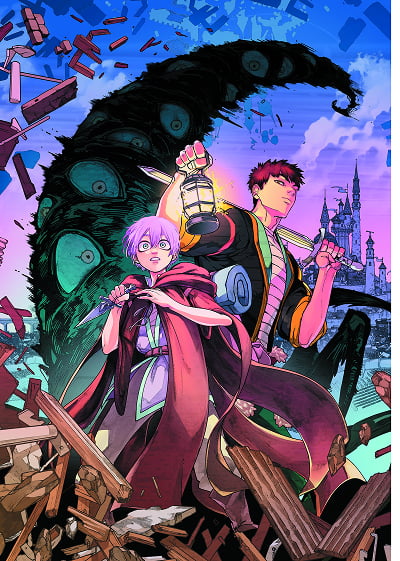
Image source: the Kyoto International Manga Museum's page for "Children Who Grew Up With Manga" (kyotomm.jp). Meaheim, written by Kenji Tsurubuchi and drawn by Konata. Rights in the image belong to the creators and Kodansha.
What "came back" means here
The second section is titled "The Former Children Who Came Back as Manga Creators." Its wall text explains: "Among the European fans who grew up in contact with Manga from childhood, some chose the path of the creator. In the work of European-born Manga creators who began appearing around 2000, many take a form close to Japanese work while showing diverse themes and distinctive perspectives"1.
That is written as a story about individuals crossing from reader to author. Someone read manga as a child, grew up, drew manga, and the result hangs here.
Matagi Gunner and Meaheim do not sit comfortably inside that story. In both, what the European creator supplies is the art. The story is written by a Japanese author. The venue of publication is a Japanese magazine and the collected volumes come from a Japanese publisher.
What came back may be less the creators than the system that employs them.
Split the story credit from the art credit, involve an editor from the planning stage, serialise in a magazine, collect into volumes. This division is less conspicuous than a drawing style, but it is the skeleton that makes manga work as a form. Over the forty years from the late 1980s, what crossed into Europe was not only how characters are drawn and read; the skeleton went too. And where the skeleton landed, a route opened for Japanese magazines to hire European artists.
This points somewhere different from the wall text's account of work that "takes a form close to Japanese work while showing diverse themes and distinctive perspectives." The text emphasises European distinctiveness. But for these two entries at least, the form is close not because of influence but because they are inside the same editorial department.
The symposium's second half names it
This is not a reading imported from outside the show. The way the associated events are built points at the same place.
The symposium "What Shapes Manga," on 28 November, has two halves. The second (14:45–16:00) is titled "What Shapes Manga: Sites of Production Connecting Japan and Europe," and its speakers are Konata, the Spanish-born Manga creator, and Ayane Chiba, an editor at Kodansha. They will talk about "the production and publishing side of the work"1.
The artist of Meaheim, and an editor from the Japanese publisher. What gets discussed as "sites of production" in that pairing is not style.
The first half (12:30–14:30) runs the same way. Titled "What Shapes Manga: Manga Production in Europe," its speakers are Yoann Vornière (France), Sozan Coskun (Germany), and Cristian Posocco — editorial manager at the Italian publisher Star Comics1. Here too, someone from the editorial side takes the stage alongside the creators.
The exhibition title is about children. Both halves of the symposium are about editing and publishing. What the venue offers as the endpoint of forty years of reception reads less like readers becoming authors than like a production system crossing a border.
What stays unknown
A good deal about this show cannot be established from public information.
The total number of participating creators is unknown. The official checklist ends at ten entries and "and others," without saying how many groups or people there are in all. The figure does not appear in the Kyoto Seika announcement, the City of Kyoto listing, the Agency for Cultural Affairs' Media Arts Current Contents, or the exhibition-information sites5.
The number of exhibits is unknown. How many reproduction prints, whether doujinshi or magazines or interview footage are included and in what quantity — none of the sources checked say5. The wall text says the first section treats reception history through the keywords "anime boom, fan communities, media, translation, education," but not what it shows to do so1.
For the remaining four slashed pairs — Diane Truc / Rutile, Guillaume Singelin / Mathieu Bablet, Hagane / Izu — the split is not determinable from the official page. This article assigns roles only to Matagi Gunner and Meaheim, which is as far as publisher listings go.
And there appears to be no independent reporting on the exhibition. The exhibition sites and the Agency's listing both organise the organiser's own description; neither was written by someone who walked through the rooms5. This article sits under the same constraint.
If you go, late November is where it concentrates
All three associated events fall in the last stretch of November1.
22 November (Sun), 13:00–15:30, Gallery 6: a talk by Mogiko. Fifty places, consecutive interpreting between Japanese and Italian, advance registration, which opened at noon on 21 July. Numbered tickets for the signing are handed out from 12:30 on the day, first come first served.
25 November (Wed), 13:00–16:00, Workshop Corner on the first floor: the live drawing session "The Future of Manga, Being Drawn." Yoann Vornière, Konata, Mogiko, Sozan Coskun and others take part, and it has no capacity limit and no registration — you can arrive late and leave early. Admission to the museum is free that day for Kansai Culture Day. Of the three, this is the easiest door.
28 November (Sat), 12:30–16:00, Multipurpose Screening Hall on the first floor: the symposium. Two hundred places, advance registration.
Note that 24 November (Tue) is a closed day, and that of the usual Wednesday closures, 23 September and 25 November are open. Only 19 and 20 September ran until 19:00, timed to Kyoto International Manga Anime Fair1. The museum closes from 26 December to 6 January.
The City of Kyoto's listing places this show as the second in a series of twentieth-anniversary exhibitions6. Twenty years of the museum, forty years of Europe. The arithmetic is tidy. What is actually on the walls is probably less so.
Sources
- Children Who Grew Up With Manga: Forty Years of Manga Culture in Europe — Kyoto International Manga Museum
- Exhibition announcement — Kyoto Seika University
- Twentieth-anniversary programme — City of Kyoto
- Matagi Gunner — Morning (Kodansha)
- Matagi Gunner vol. 1 — Kodansha
- Meaheim — Morning (Kodansha)
- Meaheim serialisation announcement — Morning (Kodansha)
- The consortium for manga abroad, and what JManga left behind
- Why France's Cat's Eye landed
Footnotes
-
The Kyoto International Manga Museum's official exhibition page. Dates 17 September 2026 to 19 January 2027; Galleries 1, 2 and 3 on the second floor; open 10:00–17:00 (last admission 16:30), and 10:00–19:00 (last admission 18:30) on 19 and 20 September; closed Wednesdays except 23 September and 25 November, and on 24 September, 11 October, 12 October, 29 October, 24 November, and from 26 December 2026 to 6 January 2027; viewing free with museum admission payable separately; admission free on 25 November for Kansai Culture Day. Organised by the Kyoto International Manga Museum and the International Manga Research Center, Kyoto Seika University; co-organised by the Kyoto Shimbun and the Kyoto International Manga Anime Fair executive committee; with cooperation from the Istituto Italiano di Cultura Osaka, the Goethe-Institut, and the Instituto Cervantes. The three-part wall text, the alphabetical checklist of creators and works, and the dates, venues, capacities, languages and registration details for the three associated events are all from this page. The page carries no posting date (checked 18 September 2026). ↩ ↩2 ↩3 ↩4 ↩5 ↩6 ↩7 ↩8 ↩9
-
The official Morning work page and the volume 1 product page from Kodansha. Matagi Gunner is written by Shoji Fujimoto and drawn by Juan Albarran; serialisation began in Morning in 2022, and as of September 2026 the collected edition runs to eleven volumes. Juan Albarran is from Spain and drew for DC Comics from 2013, including Justice League and Suicide Squad, before this, his first manga serialisation. ↩ ↩2
-
The official Morning work page and the volume 1 product page from Kodansha. Meaheim is written by Kenji Tsurubuchi and drawn by Konata; serialisation began on the web platform Morning Two on 22 May 2025. Tsurubuchi also serialises Tōge Oni in KADOKAWA's Harta. Konata is from Spain and published a first serialised work, Kohva, with Planeta, before making a Japanese serialisation debut with this title. ↩ ↩2
-
The serialisation announcement on the official Morning site. The framing "Kenji Tsurubuchi of Tōge Oni × Konata, the prodigy of Spanish comics" is from this page. ↩
-
The total number of participating creators, the number of reproduction prints, the types and quantities of exhibits such as doujinshi, magazines and interview footage, and any supporting organisations could not be found in the Kyoto International Manga Museum's official page, the Kyoto Seika University announcement, the City of Kyoto listing (posted 2 April 2026), the Agency for Cultural Affairs' Media Arts Current Contents, or artexhibition.jp (posted 9 September 2026), as checked on 18 September 2026. This article does not use those figures. The Kyoto Seika announcement does state that "this event is held as part of the programme marking 160 years of diplomatic relations between Japan and Italy," but that is attached to the talk event rather than given as the framing of the exhibition as a whole. ↩ ↩2 ↩3
-
The City of Kyoto page, posted 2 April 2026. At that point the title was provisional and the dates were given loosely as "mid-September 2026 to mid-January 2027." It places the show as the second in a series of twentieth-anniversary exhibitions. ↩